Sixty high school students a year attend classes at the Port of Everett Marina, earn associate degrees alongside their diplomas, and conduct research in Possession Sound.
Their work is now part of the international scientific record.
Everett Community College's Ocean Research College Academy published a peer-reviewed chapter in a United Nations Ocean Decade research volume released by Springer Nature in 2026.
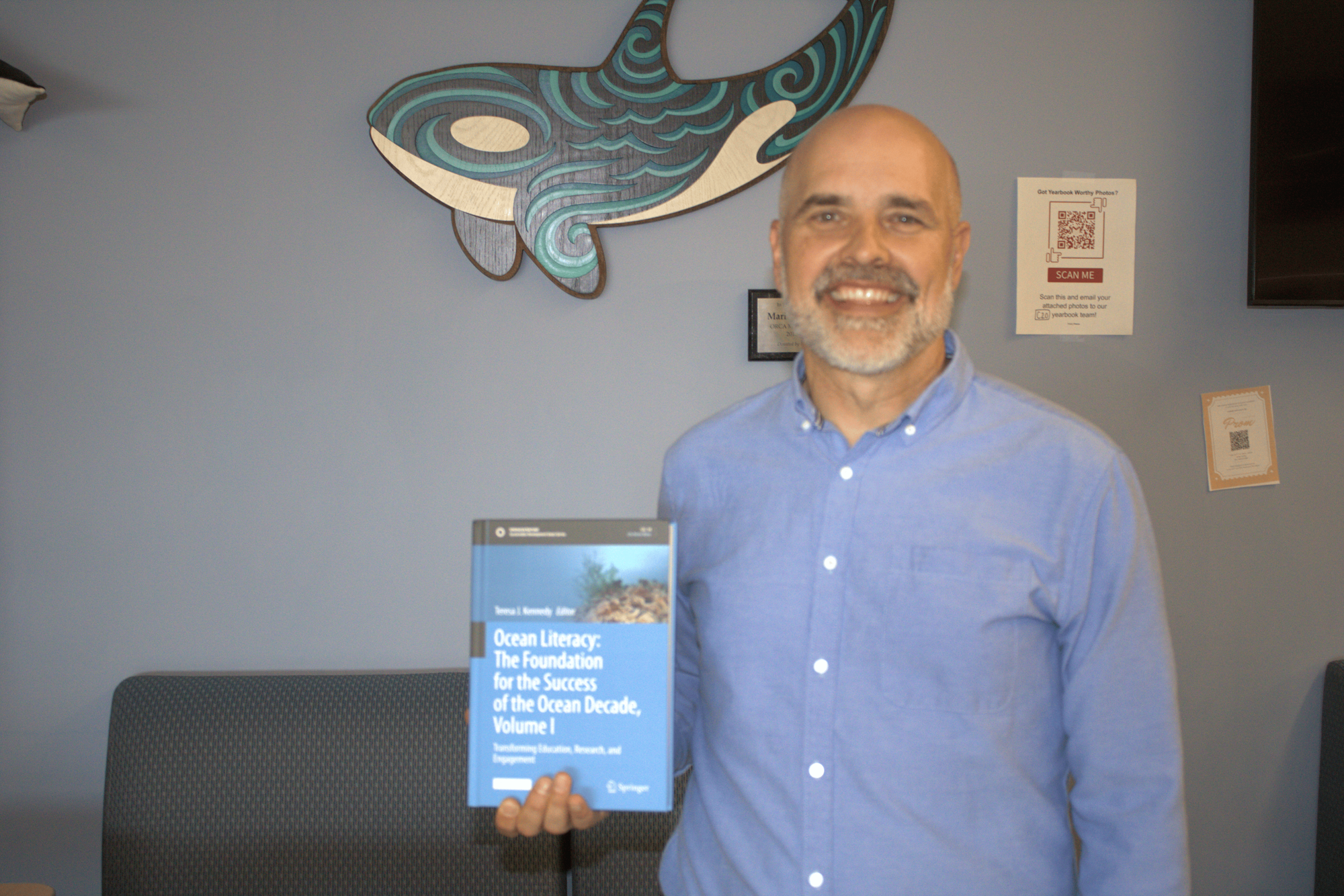
The chapter, co-authored by ORCA Executive Director Ardi Kveven and Founding Faculty member Josh Searle, appears in "Ocean Literacy: The Foundation for the Success of the Ocean Decade, Volume I," alongside contributions from more than 90 researchers across 19 countries.
The open-access chapter had recorded more than 3,300 downloads as of July 4.
"We were asked and really honored … to put it together," Searle told The Clipper, EvCC's student newspaper, in a June 6 report.
Titled "The Ocean We Have: A Case Study at the Ocean Research College Academy," the 14-page chapter draws on an alumni survey funded by a National Science Foundation GEOPATHS-EXTRA grant. Kveven and Searle sent the survey to 53 former students; 36 responded. On a five-point scale measuring how much the program changed their understanding of the ocean, alumni averaged 4.2 out of 5.
Five themes emerged from the qualitative responses: the power of questions, the importance of community, experience in place, interdependence of ecosystem parameters, and the role of data in transforming understanding.
ORCA is a free Running Start program for 15- and 16-year-olds. Students take the same first-quarter course, "Negotiating Nature," then roughly two-thirds go on to conduct research directly tied to the local estuary.
They learn the statistical tool R and collect data aboard the program's research vessel, the R/V Phocoena, named for the harbor porpoise.
The program opened in 2004 after Kveven proposed it to EvCC in 2003 and secured a Bill and Melinda Gates Foundation grant. It moved to its permanent facility at the marina in 2013. Over 85% of incoming students complete the two-year program, according to the Springer chapter.
About 70% of ORCA students identify as female. Students of color, first-generation college students, and low-income students together make up roughly 25% of the student population, the chapter reports.
Kveven is retiring after leading ORCA since its inception, the Everett Herald reported on June 15. Searle will succeed her as executive director. EvCC President Chemene Crawford called ORCA "one of the shining jewels" of the college in a statement marking Kveven's departure.
The three-volume UN series, endorsed by the UNESCO Intergovernmental Oceanographic Commission, features more than 250 authors from 42 countries. Kveven and Searle used a portion of their NSF grant to make the ORCA chapter freely downloadable, ensuring any Everett family can read it without a subscription.